For a successful future, today’s kids need to go beyond using artificial intelligence. They need to understand how AI works to be able to become AI creators – not just consumers.
Generation Alpha (2010–2024) and the emerging Generation Beta (2025–2039) are widely considered the “AI Generation” because they are the first to grow up with artificial intelligence. These kids are the first to treat AI as ubiquitous and have AI integrated into their lives from birth. On a daily basis, they use voice commands to prompt smart devices and rely on AI tools to learn, engage, and even socialize.
But that’s just the basics.
Kids who become AI creators will have a strong advantage because:
- They are able to design, code, and train AI systems
- They understand the dangers and ethical implications of AI
- They can critically evaluate AI results, not just accept them
- They have access to future industries based on AI
Early exposure to AI will unlock these opportunities, but there are fundamental skills needed for kids to master AI.
In this article, I’ll highlight the top skills that the AI generation needs to become tomorrow’s AI leaders.
5 Essential Skills for Kids to Become AI Creators
1. Computational Thinking: Problem-Solving Like a Programmer
Computational thinking is the process of thinking through a problem step by step in a measured and logical manner.
Computational thinking involves:
- Decomposition – the process of breaking problems down into their component parts and steps.
- Pattern Recognition – the ability to spot the instructions that repeat.
- Pattern Abstraction – the process of taking the patterns you’ve identified and using what you know about them to make the process quicker.
- Algorithmic Design – the process of ordering the steps so you (or someone else) can follow them to come out with the correct results every time
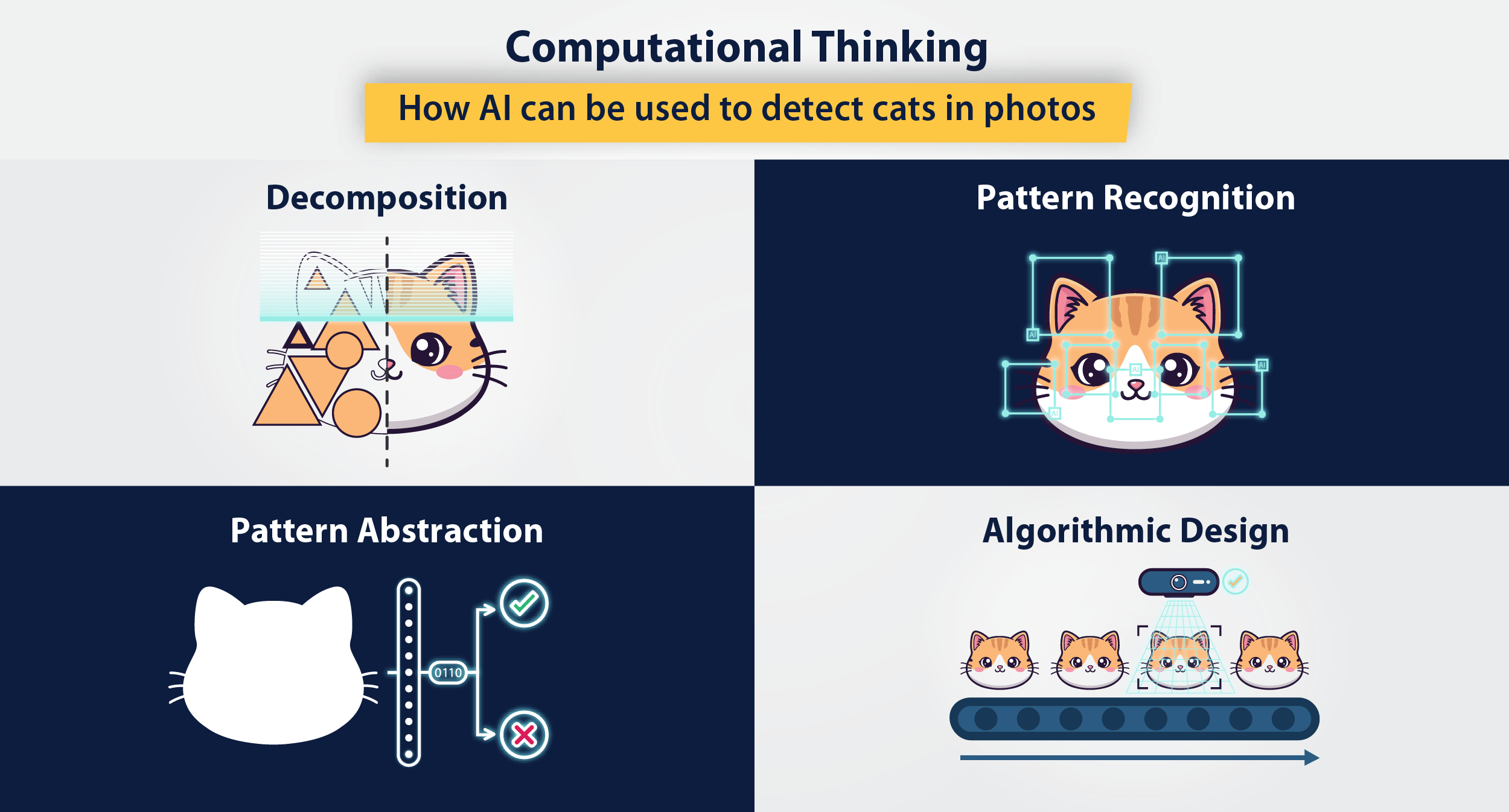
This process allows kids to take large problems and break them into simpler steps, therefore creating logical solutions.
AI applications are built to solve complex problems, like recognizing faces or recommending products. AI does this by using algorithms, a set of rules or instructions. Kids who think computationally can understand exactly how AI thinks.
For example, AI can be used to detect cats in photos by:
- Identifying edges and shapes in the image (Decomposition)
- Recognizing patterns consistent with cat features (Pattern Recognition)
- Using those patterns to classify the image as “cat” or “not cat” (Pattern Abstraction)
- Creating an algorithm to repeat this process (Algorithmic Design)
Computational thinking skills can be developed through learning to code. Coding has a distinct advantage over other methods because computational thinking is the foundation of every stage of coding, from beginning to end.
Having strong computational thinking lets kids design algorithms and AI workflows instead of just using AI.
2. Coding & Programming: Talking to Computers
Coding is using a set of instructions to communicate with computers. Coding languages like Python and Java are different ways to communicate with computers and give computers instructions on how to do specific tasks.
AI doesn’t work on its own; it follows the instructions, logic, and algorithms we write in code. But AI can also write code, so should your child still learn to code? AI can generate pieces of code, but only kids who know programming can take those pieces and assemble complete, working solutions. AI models learn from vast sets of data, so coding is required to:
- Load and clean data
- Define how the model will process information
- Adjust the model as it learns to improve accuracy
Let’s use the example of a self-driving car. AI is the brain, and code controls the brain. Self-driving cars use hardware like cameras, radar, and lidar to gather data from the world – but they don’t know what to do with that data.
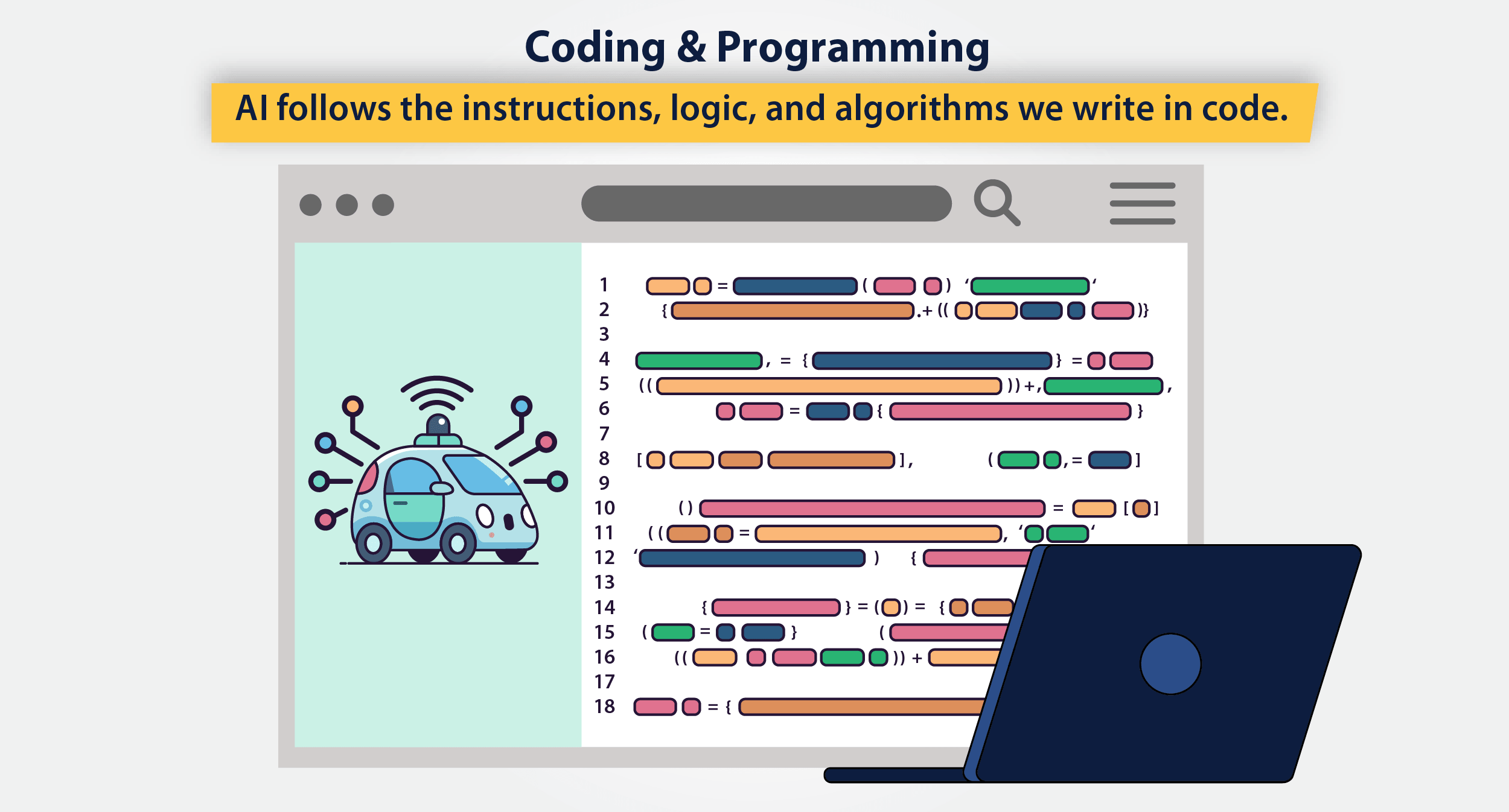
The code tells the AI how to use the data to detect lane lines on the road, identify other cars, pedestrians, and obstacles, and recognize traffic signs and lights. Code also creates algorithms to decide what to do with the data received, such as using the lane lines detected by the camera to keep the car in its lane or the traffic signs detected to slow down for pedestrians.
AI doesn’t always get it right, though. Coding allows kids to test AI outputs, fix mistakes in logic or data handling, and refine AI systems to improve over time.
Therefore, coding is a foundational skill for AI mastery. Without coding experience, kids can only be AI consumers and not creators.
3. Data Literacy: Understanding How AI Learns
Data literacy is the ability for kids to read, work with, analyze, and communicate with data. This helps them drive informed decisions and solve problems. Data literacy requires technical skills like analysis, visualization, statistics, and non-technical skills like critical thinking, data storytelling, and domain knowledge.
Data visualization – Tree Map
One way to visualize large sets of data is a tree map like this:
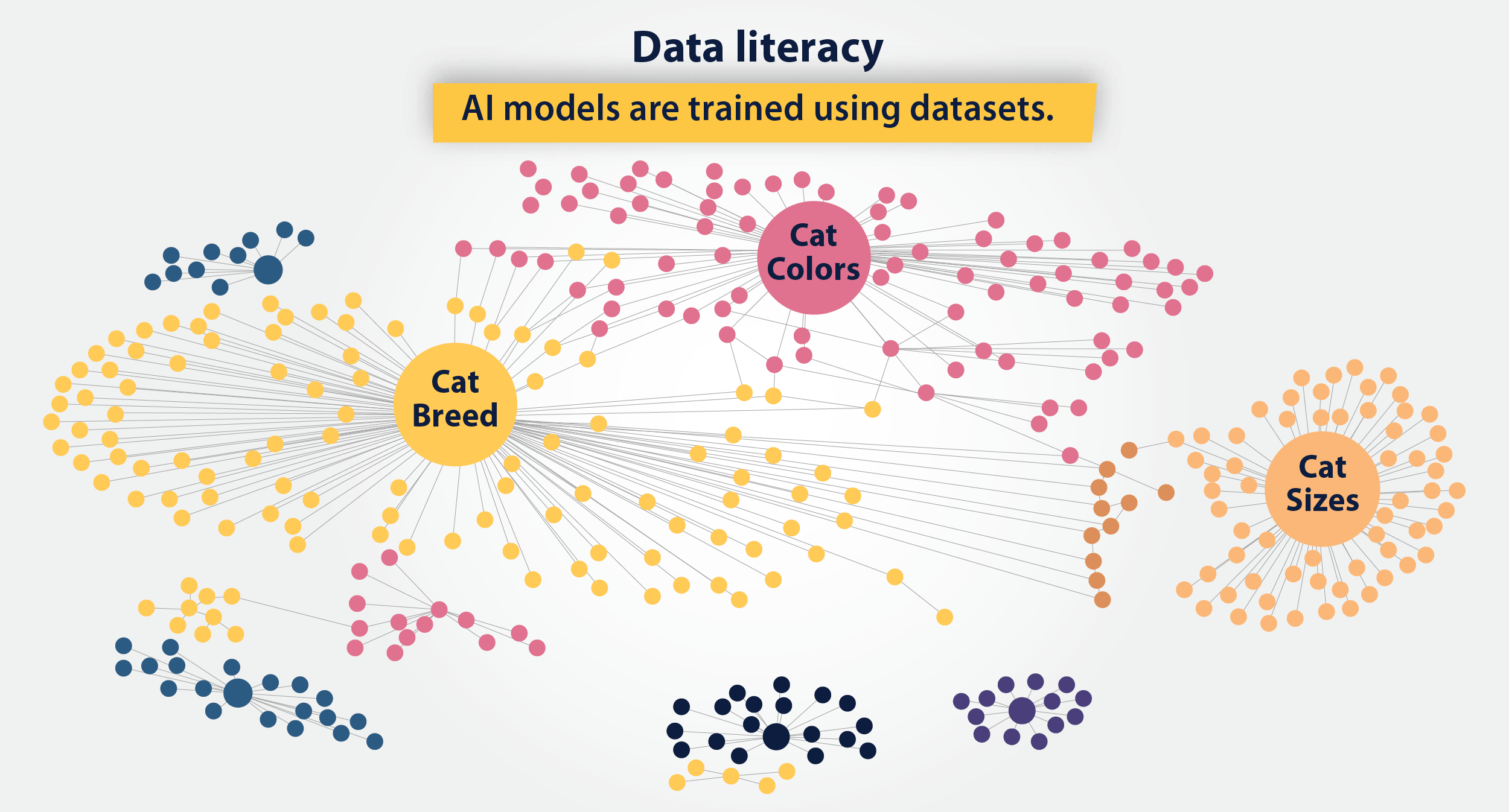
Data-literate kids understand data, how it’s collected, and how AI uses it to learn. They can effectively interpret data, argue with data, and understand its context. In addition, it allows kids to train AI effectively and responsibly.
Since data is what powers AI and its learning models, it’s extremely important. Data teaches AI how to “think.” AI models are trained using datasets. They learn patterns, rules, and decisions by analyzing this data. The more quality data AI has, the better it performs. Once AI is trained using data, it can predict outcomes and make decisions. AI systems also improve as they collect more data. Every interaction provides information that the AI can use to get better.
For example, a data set may contain thousands of pictures labeled as “cats” or “not cats”. We give AI this set of data so it can learn patterns and understand which images are “cats”. Next, the AI will create an algorithm to find patterns and adjust internal rules to predict whether an image is a cat or not.
After that, we will train the AI by feeding it pictures. It will predict if the image is a cat or not. If AI makes a mistake, it will be flagged and AI will learn from that mistake. Once trained, the AI can now recognize cats in new images it has never seen before.
Because AI learns through patterns in data, understanding data is fundamental to understanding AI. Without the understanding of what data is, how it’s collected, and how it’s analyzed, kids will only ever see the surface results of AI.
4. Creativity & Innovation: Imagining New Solutions
Creativity is essential to AI because AI alone can’t imagine or invent—it only follows patterns in data. People provide the ideas, vision, and problem-solving that make AI useful, ethical, and innovative.
AI simply can’t replace human logic, creativity, or curiosity. On its own, AI can’t create new ideas. Kids have the ability to use their imaginations to design and innovate AI-powered solutions to real-world problems.
One example is AI-generated music. AI is amazing at analyzing data, recognizing patterns, and predicting outcomes—but it doesn’t create new ideas on its own. AI can generate music by analyzing thousands of songs, but it can’t create an entirely new sound. It also doesn’t know what would sound fun, emotional, or meaningful to people without creative guidance.
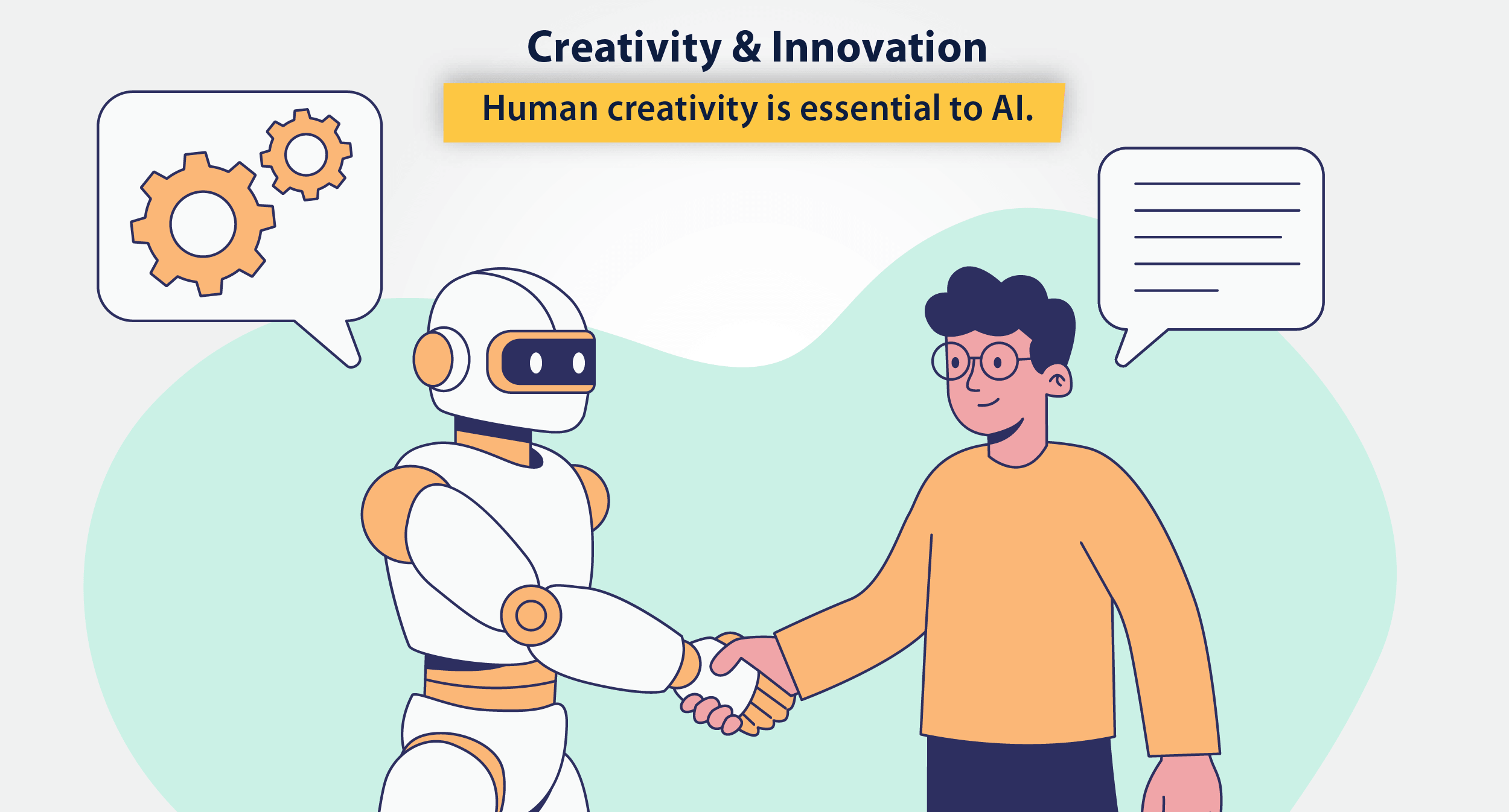
AI follows a set of rules, but it doesn’t understand fairness, empathy, or human values. Creativity allows kids to design AI that is ethical, inclusive, and innovative. They can help decide what features promote healthy rather than harmful behavior.
Ultimately, kids and their creative thinking are required to provide the innovative solutions that AI implements. Creativity is what turns AI into something meaningful and impactful.
5. Critical Thinking: Questioning AI Technology
Critical thinking for kids is the ability to objectively analyze and evaluate a problem to form a judgment or solution. It is the understanding that new ideas deserve to be scrutinized, even if they appear to hold up, and the ability to explore them through rigorous analysis.
AI has its limitations, and critical thinking teaches kids to question AI outputs instead of accepting them blindly. AI can make mistakes, misunderstand data, or produce biased results, so kids should be able to analyze how AI arrives at a conclusion. They’ll learn to consider the data, algorithms, and logic behind AI predictions. Kids learn to spot errors and ask: “Why did the AI make this decision?”
6 Key Elements of Critical Thinking
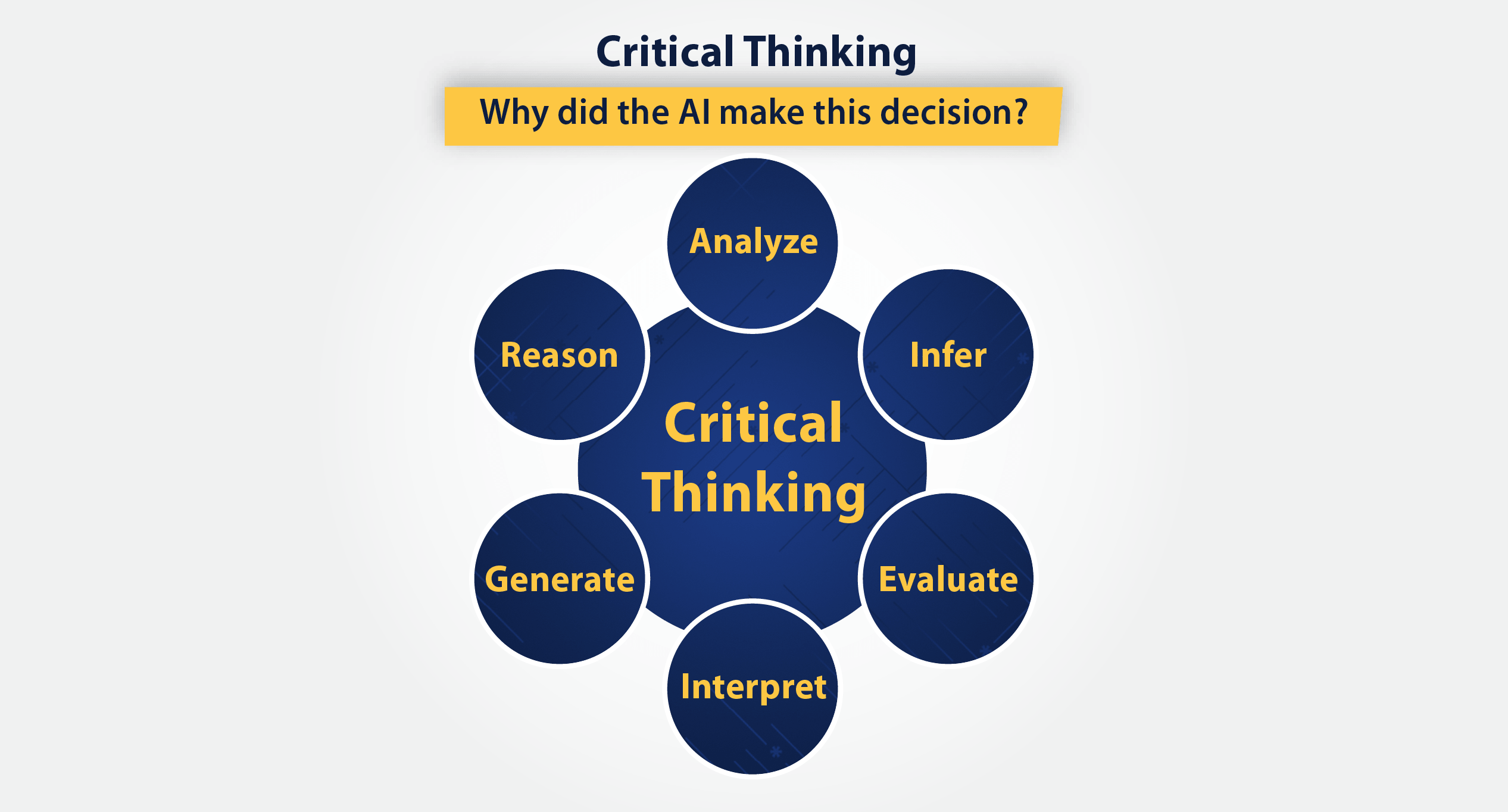
For kids using YouTube, they might notice all of their recommendations are superhero videos, even though they are interested in science videos too. They could ask themselves, “Why are all my suggestions superheroes? I also like science videos!” By doing this, they’re thinking critically about the results and spotting patterns that don’t match reality. They can question the AI logic and assumptions by thinking, “Did the AI only see me watch superhero videos recently?” or “Does it think I don’t like science videos?” Then, they can fix this by understanding the algorithm, watching and liking some science experiment videos, or giving feedback to the AI.
Kids have to use their critical thinking skills to evaluate, iterate, and learn from AI outputs. If they think critically about these outputs, they can identify bias or unfairness and propose better solutions. It encourages them to think about the broader implications of AI technology.
Critical thinking skill turns kids from passive users into responsible creators. As creators, they can design systems that promote fairness, inclusivity, and ethical AI use.
Why Start Early? Gen Alpha & Beta Need AI Skills
AI isn’t coming—it’s already here. AI mastery is one of the best ways for kids to get ahead and prepare for the future.
By learning these skills now, kids gain the confidence, creativity, and technical expertise to thrive and lead in an AI-driven world.
At CodeWizardsHQ, our live, online coding classes teach kids all of these skills in a fun and engaging way. Through a structured curriculum and hands-on projects, students learn the fundamental skills needed to work with artificial intelligence.
In our 2-day AI camps, kids can learn to build their very first AI model and how to use AI to solve real-world problems. This is one of the best ways to explore your child’s interest in artificial intelligence and machine learning.
By the end of our programs, kids aren’t just using technology—they’re creating it.
Give your child the tools to understand, create, and lead in an AI-powered world today. Explore our top-rated kids coding programs.